
History
The Church of Santa Maria della Strada in Matrice, originally part of a Benedictine settlement, is located about ten kilometers west of Campobasso. Its very name derives from the tratturello Candela, a transhumance route that linked Abruzzo with Apulia. The site is strategic: a crossroads between mountain and plain, between Samnium and the Adriatic, chosen over the centuries for its proximity to agricultural and mineral resources. Added to this is the symbolic charm of its function as a place of worship for pilgrims traveling along the tratturo, or, from the Greek Hodòs (“way, guide of the road”), from which the church takes its epithet.
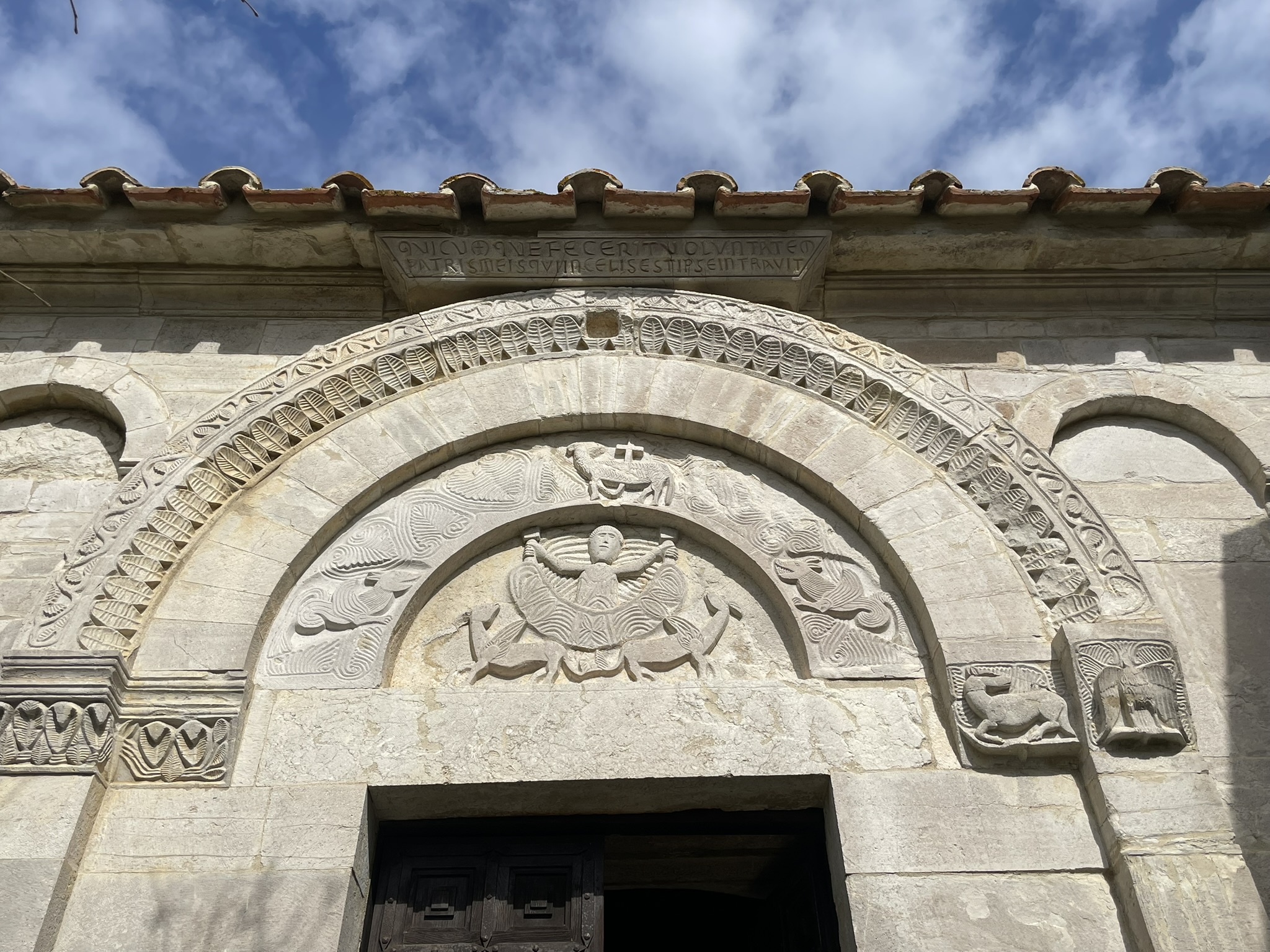
The site was already frequented from the Late Bronze Age (1350–1200 BC) through the Early Iron Age (950 BC), and later in Roman times, as archaeological discoveries attest. At the beginning and end of the 7th century, the fief of Matrice was documented, with Aveliero donating the land on which the monument stands, as recorded in a Byzantine inscription in the chapel of Saints Cosmas and Damian. The first church was consecrated in 1148 by Archbishop Pietro of Benevento, and it remains one of the most significant examples of Romanesque architecture in Molise. Surrounding it are structures and plains with additional arcades arranged in two semicircles. The ancient abbey palace and the bell tower complete the site. The façade, built of finely worked squared stone blocks without plaster, is of remarkable workmanship, with a central portal emphasizing its unified decorative and architectural design. Alongside the adjacent structures, a rich cycle of bas-reliefs begins to unfold. The interior is divided into three naves with pillars decorated with vegetal motifs.
The roof, once with vaults and ribbed cross vaults, today features wooden trusses. Among the decorations are a wooden statue of the Madonna and Child, a travertine Crucifix, and the tomb of Berardo D’Aquino. The decorative elements reflect the meeting of Latin, Byzantine, and Nordic cultures, with Norman influence. In 1889, the entire Benedictine abbey complex was declared a National Monument.