The Church
FAÇADE
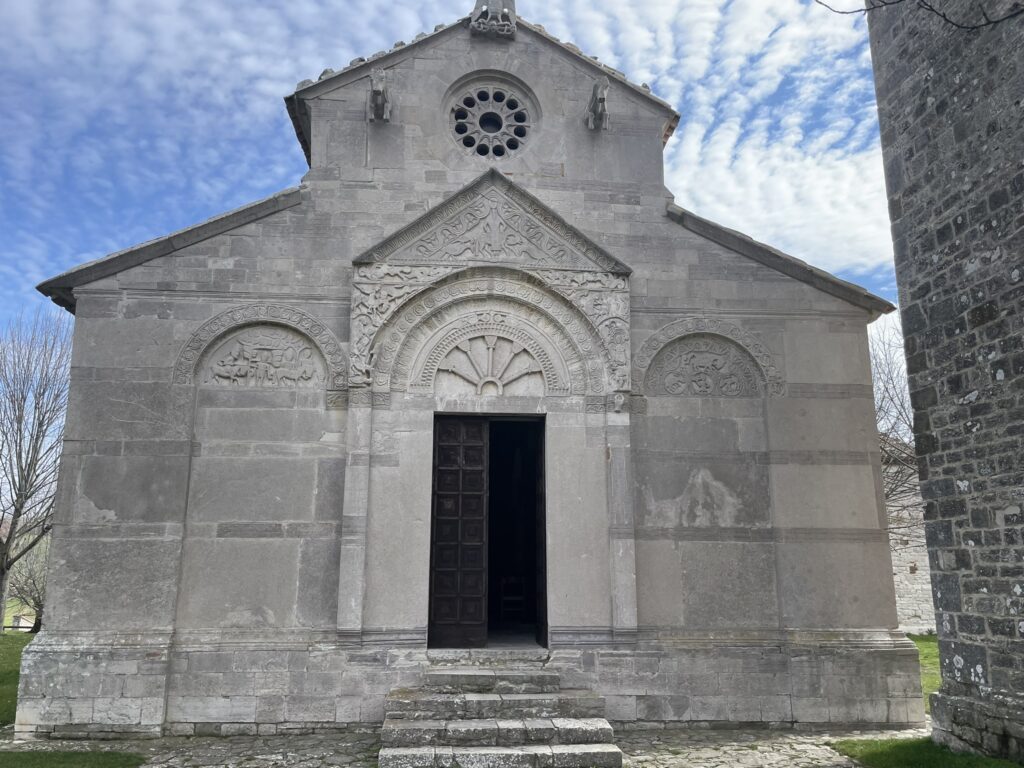
The façade of Santa Maria della Strada, built between the 11th and 12th centuries in the Romanesque-Lombard style with squared stone blocks in exposed masonry, is of remarkable workmanship. The central portal is topped by a flattened porch supported by alternating bundles and blind arches with lunettes. A rich cycle of bas-reliefs with biblical scenes and geometric motifs makes this church unique. Many of the figures carved on the façade recall the symbolism of resurrection, eternal life, and the victory of good over evil, though their interpretation remains uncertain.
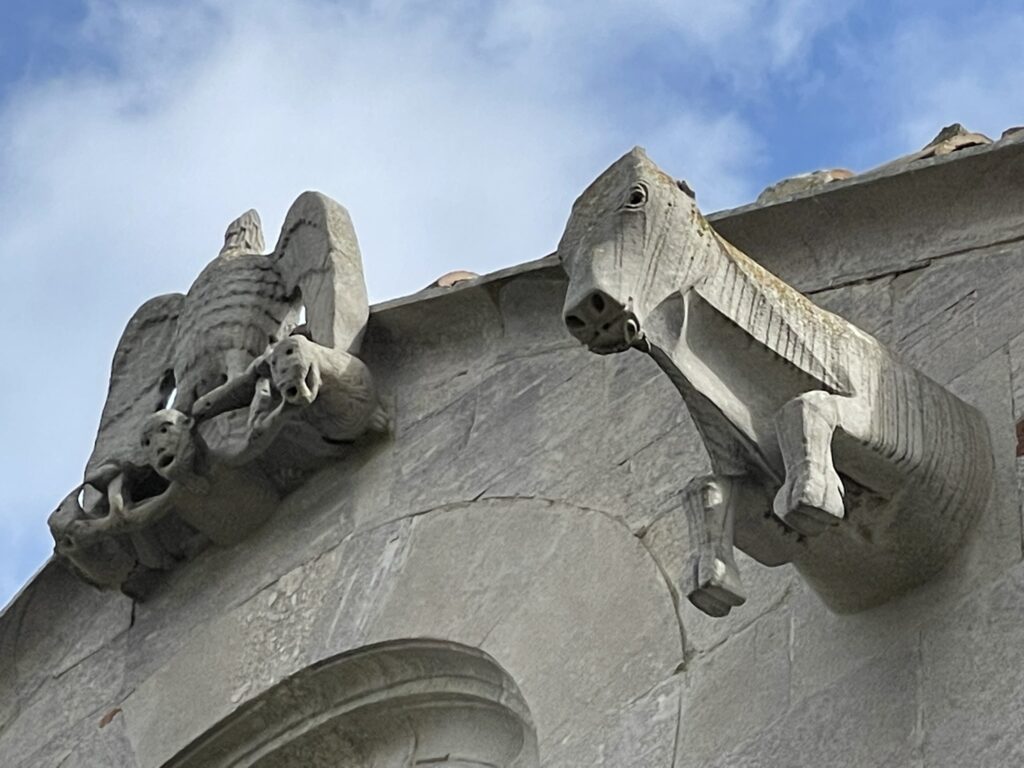
EAGLE
At the top of the tympanum, an eagle, symbol of Christ, holds depictions of evil in its claws, surrounded by serpents: in the center, a man with a short beard and firm expression; on the right, a feline; on the left, another creature overturned on its back, also resembling a feline. Together, they form a sort of column with capitals connected by small arches. Further below we see, at the center, the underside of a colonnade. This evokes the symbolism of the twelve gates of the Heavenly Jerusalem, representing the perfection of the city of the Apocalypse. On the sides, two half-busts with forelegs represent strength and patience, and are linked to the legend of King Bove.
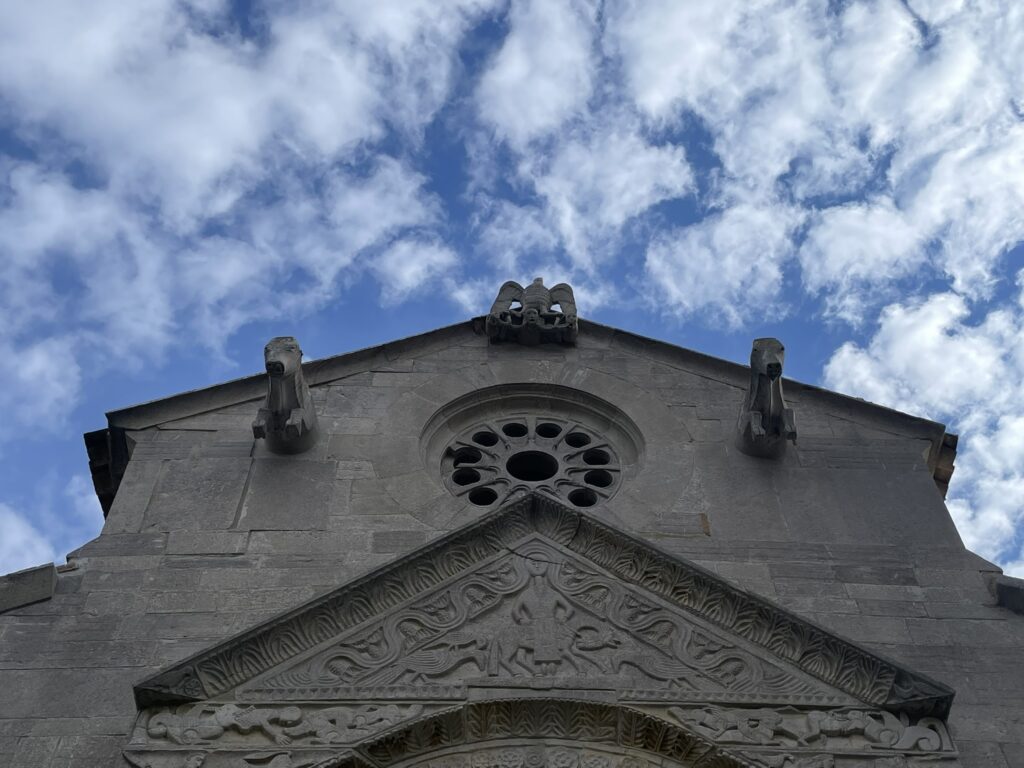
TYMPANUM
At the center of the tympanum dominates a frontal figure on horseback, flanked by three birds. Beneath the tympanum, two symmetrical pairs of animals are shown fighting. The whole is difficult to interpret: the central figure could be either male or female. In the first case, it would represent Christ as the apocalyptic rider, portrayed in an iconic frontal position despite being on horseback. If instead it is a female figure, she extends her weapon or cross, strengthening the robes and attributes of Our Lady of the Strada. Christ on the mount with a celestial diadem, bride of Christ.
On either side of the figure, two masters allude to Christ’s victory over death and the crown of hell. In the small field, the battle between paired opposing creatures refers to Christ who, through death, triumphs with the crown, against the volutes that run along the upper sides of the tympanum. These enclose twelve identical vegetal elements, perhaps small trees resembling palms, also symbols of immortality. The volute has also been interpreted as a representation of a river, possibly the Jordan.
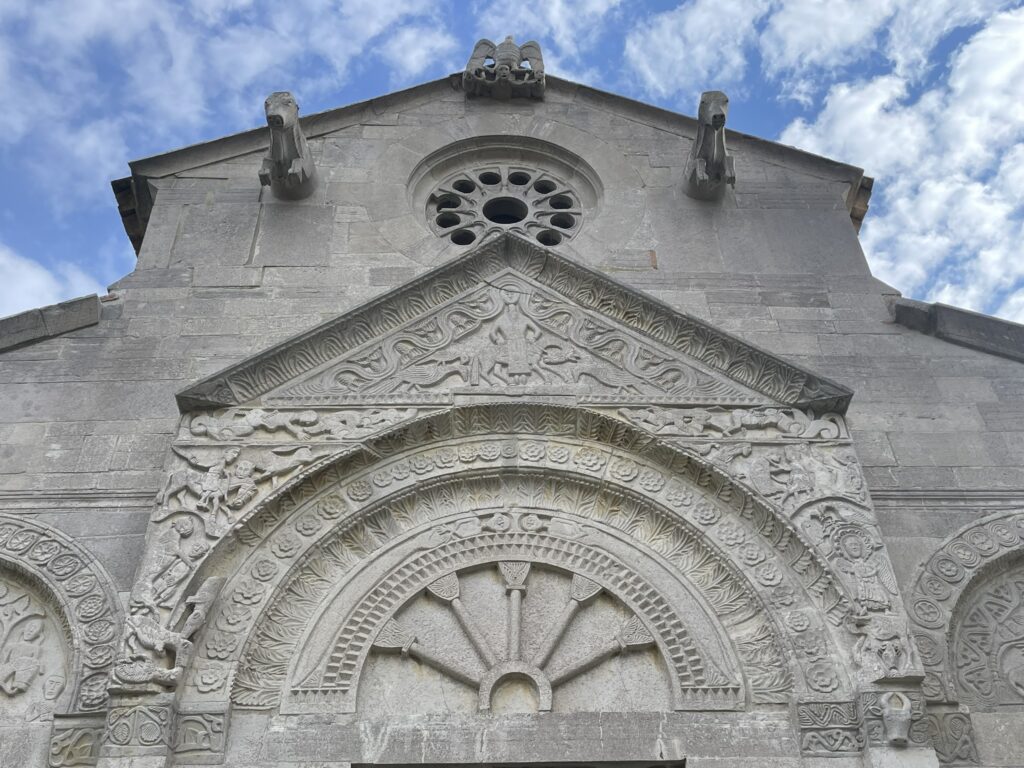
PORTAL – UPPER FRIEZE
The frieze below the tympanum represents, from right to left, the story of the prophet Jonah, a symbol of Christ’s resurrection. On the right, a sea monster, the winged ketos, swallows Jonah, revealing only his legs and torso. At the center, two small martyrs join hands while their tails intertwine. On the left, the ketos spits Jonah out, visibly alive once more. Above the portal, a series of concentric arches are decorated with leaf motifs, rosettes, and dentils. Two sculpted dragons devour two men, an allegory of Christian death.
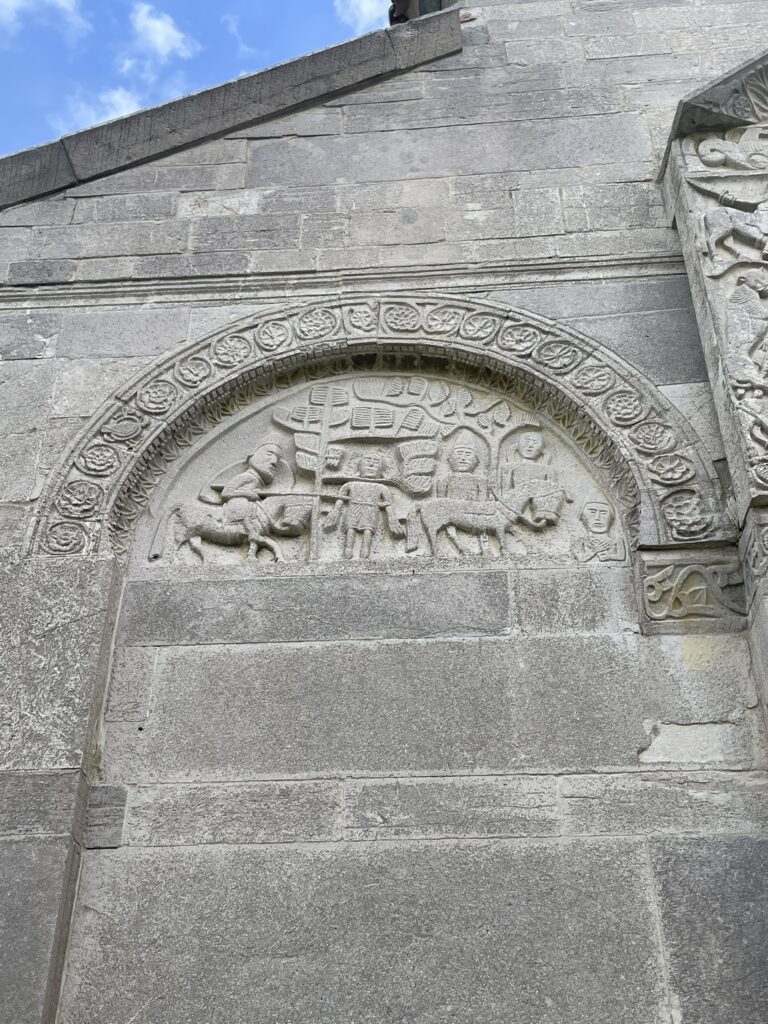
LUNETTE OF THE LEFT SIDE ARCH
On the left: a knight pierces a man with a lance, next to a horse tied to a tree, in the presence of other figures. The scene may represent the Old Testament account of Joab killing Absalom, or, from the Chanson de Geste, Fioravante slaying the Saracens and freeing a maiden—the figure at the far right.
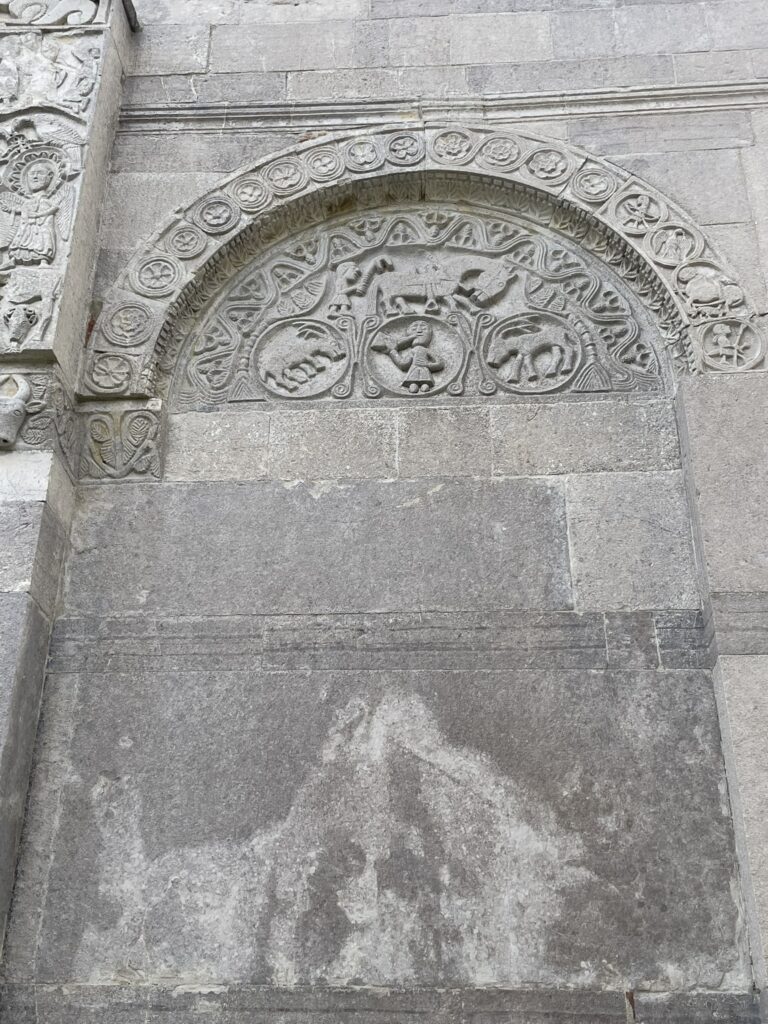
LUNETTE OF THE RIGHT SIDE ARCH
On the right: a man with a staff follows a bridled horse, and within the three spirals at the center, a man blows a horn, flanked by two deer. The whole may refer to the Chanson de Roland, depicted above with his sword and horse, and below as he blows the horn to summon Charlemagne.